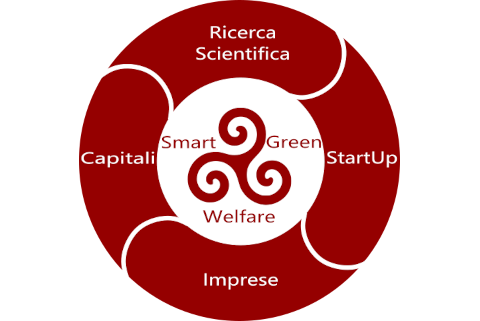

Cultural Attractors in Complex Systems: The Case of Salento
In the context of complex systems theory, an attractor represents a state toward which a system tends to converge, a final configuration in which all its variables— economic, cultural, social, infrastructural — realign and transform to define a new dynamic equilibrium. Applied to the territorial system, a cultural attractor cannot be reduced to a single element, such as a tourist resource or a cultural asset, but is configured as an emergent state where every component of the system contributes to a shared and integrated narrative of development.
The case of Salento: “Lu sule, lu mare e lu ientu” and the failure of the monopolicy
A significant example of a poorly conceived cultural attractor is represented by the case of Salento, where for decades territorial governance promoted a monopolicy exclusively centered on the enhancement of environmental resources, summarized in the narrative “lu sule, lu mare e lu ientu” (“the sun, the sea, and the wind”). Although this approach was appealing, it proved limiting, establishing a political monoculture in which every potential for development was subordinated to tourism and the creation of an image of an uncontaminated natural oasis. The crucial question is: can a complex system such as an entire territory fully converge toward such a reductive attractor? And, above all, can tourism alone sustain the economy, culture, and future of a territory so rich in diversity and complexity?
The mistakes of the monopolicy
The choice to establish governance entirely oriented toward tourism and romantic environmentalism reveals not only a simplistic vision but also strategic fragility. This approach is based on a dangerous illusion: that a single narrative, however strong, could carry the entire territorial system toward a stable state of development.
Reality, however, presents itself differently. The exclusive emphasis on tourism has led to a reduction of the territory’s cultural complexity, neglecting the richness of local symbolic resources and relegating other productive sectors to a marginal and undervalued role. This has generated social and economic exclusion, particularly for those unable to integrate into the personal symbolic resources a vision linked to tourism, resulting in growing emigration and greater fragmentation of the community. Moreover, dependency on a tourism-centered economic model exposes the system to risks of stagnation, making it vulnerable to external crises such as climate change, seasonal fluctuations, and oscillations in international tourist flows. Finally, policies exclusively focused on tourism have not promoted integrated development, neglecting improvements in infrastructure, education, and the productive sector, leaving many parts of the territory isolated from the dominant narrative.
A Diseased Governance?
Behind this seemingly naive political choice, one could read a form of pathological governance, aiming to reduce the entire territory to an idyllic and immobilized vision of a “natural oasis,” ignoring the real needs of the population and the possibilities of diversified development. Such an approach is not only shortsighted but also counterproductive, as it denies the system the possibility of evolving toward a richer and more sustainable equilibrium. In other words, it causes the emigration of entire social classes not aligned with the political monoculture.
Detachment and Risk of Collapse
In complex systems theory, the transition toward an attractor requires that all variables of the system transform coherently. In the case of Salento, this alignment did not occur. While part of the system (the tourism sector) moved toward the attractor, other components — such as education, agriculture, craftsmanship, and infrastructure — remained static or misaligned.
This process has led to evident internal detachment, manifesting in various critical issues. On one hand, there are resistances to change: sectors and communities excluded from the dominant narrative remain distant and disconnected from the transition process. On the other hand, systemic stagnation is observed, with the territory stuck in an intermediate state incapable of evolving toward a stable equilibrium or promoting structural innovations. Added to this is structural fragility, determined by the lack of economic and cultural diversification, making the system vulnerable to external shocks. This fragility contributes to demographic and social decline, while other, more dynamic territories attract human capital seeking alternative life prospects, exacerbating local depopulation.
The Role of Governance: Designing a Complex Attractor
To avoid collapse and guide a territorial system toward a stable state, governance must abandon the logic of the monopolicy and adopt a systemic approach. A sustainable cultural attractor cannot be reduced to a single narrative but must be designed as a complex state in which all components of the system evolve in a coordinated manner.
This requires a paradigm shift, starting with the promotion of narrative plurality. It is essential to move beyond the monocentric vision synthesized in the rhetoric of “lu sule, lu mare e lu ientu” and embrace a narrative that includes culture, innovation, productive traditions, and sustainability. At the center of this approach is the integration of symbolic resources, enhancing the cultural and productive diversity of the territory, creating a dynamic balance between tourism, agriculture, industrial development, and the creative industry.
At the same time, it is essential to invest in infrastructural development, strengthening both material and immaterial infrastructures, so that all components of the territorial system can grow harmoniously. Supporting these transformations requires promoting inclusive governance, in which local communities are fully involved in the decision-making process, thus ensuring active participation and authentic rooting of territorial policies.
The case of Salento demonstrates that a monopolicy based on a reductive narrative, however captivating, cannot sustain a complex system like a territory. For a territorial system to evolve toward a stable attractor, a systemic approach is necessary, in which all its variables are harmonized and integrated into a shared vision of development. Governance capable of designing a complex attractor, enhancing the plurality of symbolic resources, and investing in an inclusive and diversified narrative represents the only way to guarantee Salento a sustainable, resilient future rich in opportunities for all its inhabitants.