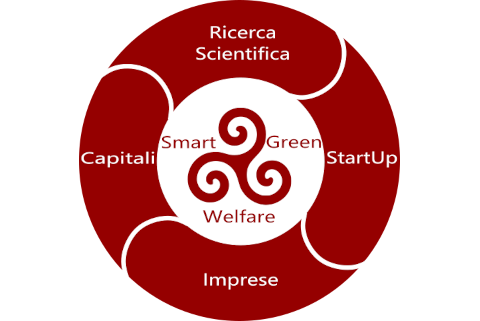

Triple Transition: towards a new socio-economic
The “triple transition” is narrated as the shift towards a socio-economic model based on three interconnected pillars: environmental sustainability (green), digital transformation (digital), and social inclusion (inclusion).
For the green transition, terms like “Green economy” are used, implying an economic paradigm based on environmental sustainability, while “Circular Economy,” as a production paradigm based on closed material cycles, also introduces the concept of “knowledge economy” as an economic paradigm induced by digital technology.
Finally, reluctantly, to respond to the growing social inequalities that have emerged from the unbalanced application of these recipes, the theme of “Just Transition” has been introduced, understood as an inclusive and fair social transition.
The narrative, through an innocent semantic operation, achieves a heterogenesis of ends, transforming a purpose into a poorly defined tool of action.
The adjectivation of the term “Economy” in expressions like “circular economy,” “green economy,” or “knowledge economy” is generally associated with the idea of an economic paradigm. However, a true economic paradigm requires the support of a solid cultural superstructure capable of justifying and sustaining it as the foundation of a systemic vision. Furthermore, an authentic economic paradigm must be sufficiently structured to guide a historical transition of the entire socio-economic system. This raises the question of whether such terms actually represent foundational and transformative economic paradigms of society, or if they are merely shared operational policies among actors, lacking a cultural and structural basis adequate to bring about deep and lasting change.
Alternatively, one could argue that such concepts do not represent true autonomous economic paradigms, but rather partial or fragmented visions of an underlying economic paradigm. This raises an interesting question: what would be the actual economic paradigm that these narratives underlie? Is it perhaps an emerging economic model capable of integrating the dimensions of environmental sustainability, technological innovation, and social justice, or are we facing a multiplicity of sectoral approaches lacking a unified and coherent vision?
Alternatively, it is possible that such narratives are rhetorical tools used to conceal, within a framework of seemingly shareable and shared goals, the maintenance of the existing economic paradigm. Greenwashing, social washing, and the strategic use of digital control could indeed serve to preserve established structures of power and profit, masking them behind the language of change and sustainability. This possibility poses an additional critical challenge: to distinguish between authentic innovation and narratives that function to perpetuate the status quo.
The goals appear to be shareable and shared:
Green (Sustainability and Circularity): Promote sustainable economic development that reduces environmental impact, ensures the satisfaction of present and future needs, and encourages the transition to a circular economy based on recycling and waste reduction.
Digital Transformation: Accelerate technological innovation to improve efficiency and create new economic opportunities.
Social Inclusion: Ensure that the transition to new economic models is fair and just, reducing inequalities, guaranteeing equal opportunities, and including the most vulnerable segments of the population.
The triple transition therefore emerges as a consequence of an environmental demand, a change in dominant technology, and the resulting social changes. The ultimate goal is therefore to identify an economic paradigm that can integrate the 3 dimensions of the transition and be inclusive of the productive and industrial system that constitutes the material infrastructure on which society stands.
It is evident that the uninvited guest of the reasoning that seems excluded from the public narrative is Capitalism and the forms in which it developed during the 20th century!
The triple transition is configured as a response to pressing environmental needs, the evolution of dominant technologies, and the resulting social changes. The final goal is to define a new economic paradigm that integrates the three dimensions of the transition – ecological, digital, and social – into a coherent and sustainable system, and that is also inclusive of the productive and industrial system, which constitutes the material infrastructure on which society is based.
However, it is evident that the “uninvited guest” in this reflection, and surprisingly absent from the public narrative, is Capitalism and its modes of development, especially those consolidated during the 20th century. This silence raises fundamental questions: is it really possible to build an economic paradigm capable of responding to the challenges of the triple transition without confronting the roots of the current economic system?
It is equally evident that the capitalist system is trying to self-regenerate to face the forced path imposed by the triple transition. It can be hypothesized that if the required transition is limited to transforming the operational modes of the system – such as internal production processes or external relations – then this regeneration could indeed occur, adapting to new needs without altering its essence.
However, if the transition touches on what the system is ontologically, that is, its fundamental structure and its “symbolic resources” (such as values, ideologies, and cultural assumptions on which it is based), then self-regeneration becomes impossible. In this case, the system could not survive the change without destroying itself, as it would be forced to give up the foundations on which it has historically grown and consolidated. This scenario therefore poses a crucial challenge for the sustainability and evolution of capitalism itself.
Economic Paradigms of the 20th Century
Classical political economy, which forms the theoretical basis of capitalism, is based on some fundamental assumptions:
- Infinite environmental resources: the system implicitly assumes that natural resources are unlimited or easily replaceable, ignoring ecological limits and environmental impact.
- Available and inexhaustible labor: human labor is seen as a production factor that is always accessible, often without considering its social and psychological implications.
- Esternalità ambientali: i costi ambientali (inquinamento, degrado delle risorse naturali) sono esclusi dal calcolo economico, trasferiti al di fuori del sistema come “effetti collaterali”.
In contrast to capitalism, socialism has promoted a model based on a principle of equality, where the economy is centralized and regulated by a single ordering entity – the State. This model aims for the fair redistribution of resources and the elimination of economic disparities. However, centralized planning has often clashed with social complexity: the diversity of needs, aspirations and local contexts have made a rigid organization difficult, leading to inefficiencies and a loss of flexibility in relation to the real dynamics of society.
Keynesianism, developed in the 20th century, represents a compromise between capitalism and socialism, proposing an active intervention of the State to mitigate market dysfunctions. Through fiscal and monetary policies, Keynesianism seeks to stabilize the economy, reduce unemployment, and promote economic growth, without questioning the foundations of capitalism. This model was successful in the context of the industrial economy, characterized by mass production, relatively predictable markets, and a hierarchical organization of labor.
However, all these economic paradigms – classical capitalism, planned socialism, and Keynesianism – are based on a model of industrial economy with specific forms of labor organization.
The economic paradigms of the 20th century were conceived to address the dichotomy between Capital and Labor, which represents the heart of the productive, social, and political dynamics of the time. This opposition, central to the economic and political thought of the last century, defined economic relations, class struggles, and models of social inclusion. Capital, representing the means of production and investments, has historically been associated with economic and industrial elites, while Labor, embodied by the workforce, has represented the productive and social base on which every economy is founded. The tension between these two poles has driven the evolution of economic and political institutions, fueling negotiations that defined rights, wages, and wealth redistribution.
The political and social system has been organized around this dichotomy, with trade unions and workers’ associations on one side, and industrial and financial confederations on the other, representing the respective parties in social bargaining, trying to mediate between the divergent interests of capital and labor. The reduction of inequalities and the guarantee of fair participation in the economic system have been objectives pursued through redistributive and welfare policies, often inspired by the Keynesian compromise, which sought to balance power between capital and labor, promoting social cohesion and economic integration.
Political forces, trade union movements, and dominant ideologies such as socialism, communism, social democracy, and liberalism were structured to respond to and manage this dialectic between capital and labor, with conflicts and alliances that shaped the politics of the 20th century. The structure of modern institutions, from national governments to local administrations, has evolved to manage this dichotomy, ensuring fair rules for production and labor, redistributive taxation, and regulations that preserve social stability.
This dichotomy has represented both a moment of clash and an ordering principle of the socio -economic system, but the transition from industrial production to digitalization has radically changed the relationship between human beings and labor, and between labor and capital.
The paradigm of Civil Economy
As described above, the terms “green economy”, “circular economy”, and “knowledge economy” do not seem to possess the theoretical foundations necessary to constitute a foundational economic paradigm capable of supporting and guiding society as a whole. Although they represent useful tools and relevant concepts for addressing specific contemporary challenges – from environmental sustainability to digital transformation – they are more configured as sectoral policies or operational approaches than as organic systems capable of integrating the various economic, social, and cultural dimensions.
To become a true economic paradigm, each of these concepts should be supported by a coherent theoretical vision, capable of redefining the productive, distributive, and institutional structures on which society rests, something that currently appears still incomplete or fragmented.
In recent decades, various attempts have emerged to overcome the limitations of Classical Political Economy, which has traditionally supported Capitalism, especially in its consolidated forms of the 20th century. These approaches seek to address the critical issues related to environmental sustainability, social inequalities, and technological transformations that are rapidly reshaping the economic and productive foundations. Organizations such as the International Monetary Fund (IMF) and the World Bank have initiated programs and policies to integrate aspects such as sustainability and social inclusion, recognizing the importance of addressing economic and environmental externalities.
However, many of the proposed interventions remain tied to an incremental logic, aiming more to mitigate the negative effects of capitalism rather than to rethink it in a systemic way. In this context, the need arises to develop a new economic paradigm that overcomes the limits of the traditional approach. Such a paradigm should first incorporate the concept of limits, recognizing the ecological boundaries of the planet and integrating environmental sustainability as a structural constraint, rather than as a mere externality to be managed.
Secondly, it should internalize the environment as a productive resource, treating natural capital not only as an asset to be preserved but as a central element in production cycles and overall economic value. Another fundamental aspect is the recognition of Human Capital as a value owned by the worker, overcoming the idea of a homogeneous and standardized “working class,” and valuing human capital in its complexity, which includes not only skills and abilities but also creativity and personal aspirations.
Furthermore, it is necessary to integrate the digital transition not only as a driver of efficiency but as a true cultural and organizational transformation that reshapes the relationships between labor, capital, and society, with particular attention to social justice. Finally, the new paradigm should ensure social inclusion, shifting the focus from an individual profit logic to a collective vision capable of balancing economic growth and social well-being.
Within such a paradigm, a rethinking of social forms and governance structures can take place. If productive organizations transform into entities that internalize the environment and human capital, the traditional boundaries between business and community begin to dissolve, orienting towards a model inspired by the olivetti vision, in which the enterprise is conceived not only as an economic engine but also as a center for social and cultural development.
In this scenario, the factory gates open to the territory and the social sphere, giving rise to a process of positive contamination between production and community. This broadening of perspectives not only promotes greater integration between economic activities and social responsibility but also modifies the dynamics of competition.
Competition between businesses shifts towards competition between territories, where the attractiveness and quality of the local context – in terms of human capital, environmental sustainability, and social cohesion – become determining factors for economic success. This transformation could redefine the very concept of competitiveness, orienting it towards the enhancement of the common good and the sustainable development of territories.
The paradigm of Civil Economy
The concept of Civil Economy presents itself as a suitable paradigm to respond to contemporary challenges, emerging as a rediscovery of ancient principles and values, reinterpreted in light of current needs. Its roots lie in the pre-classical economic tradition, developed by thinkers such as Antonio Genovesi in the 18th century, who saw the economy not only as a science of production and exchange but as a means to promote cooperation, reciprocity, and the common good.
This perspective, long overshadowed by the advent of classical political economy and its utilitarian logics, is now being reclaimed as a model capable of addressing the contradictions of traditional capitalism. Civil Economy proposes a system in which economy, environment, and society are not separate dimensions but are deeply interconnected. It overcomes the extractive and competitive logics of the modern market, offering a vision based on social inclusion, environmental sustainability, and the enhancement of human relationships as economic and cultural resources.
In this sense, Civil Economy represents a conscious return to a way of thinking and practicing economics that recognizes the intrinsic value of people, communities, and the environment, integrating these aspects into a holistic paradigm suitable for the challenges of our time.
Civil Economy is based on distinctive principles that differentiate it from classical and modern economic approaches. It proposes an integrated model centered on values such as reciprocity, the common good, and sustainability. This approach aims to overcome purely extractive and competitive logics, offering a vision of the economy that places people, relationships, and respect for the environment at its center.
Civil Economy is sharply distinguished from Political Economy by its different conception of human relationships and the purposes of economic activity. While traditional Political Economy is based on the idea of “homo homini lupus”, according to which humans act primarily in a selfish and competitive manner, Civil Economy is inspired by the opposite principle of “homo homini natura amicus”, which sees reciprocity, cooperation, and the common good as the cornerstones of economic activity.
Among the fundamental concepts that characterize Civil Economy are: productivity, which emphasizes the multiplicative value of collaboration; relational capital, which values the role of human and economic connections; and the social value of production, which integrates economic, social, and environmental impacts.
Economic value as productivity
One of the central aspects of Civil Economy is the concept of productivity, which serves as a measure of the value generated by cooperation among economic actors. Unlike Political Economy, which tends to assess value through the sum of individual contributions (for example, the sum of incomes or individual productivity), productivity represents the multiplicative value of collaborative relationships.
Mathematically, productivity is expressed as:

In this view, the value of the system is not simply the sum of contributions but a product that captures the synergies and added value of cooperative relationships. In a well- integrated system, the contribution of each actor amplifies the overall result, highlighting how collaboration can generate greater value than the simple sum of the parts.
Relational Capital: The Value of Connections
In Civil Economy, relational capital is considered a fundamental resource for the functioning of the economic system. The relationships between economic actors are not seen merely as utilitarian tools, but as generators of trust, cooperation, and sustainability. This contrasts with Political Economy, which tends to treat relationships as mere means to optimize individual transactions.
Relational capital can be mathematically expressed as:

In an economic system that values relationships, greater relational capital translates into greater efficiency, innovation, and resilience, as the connections between actors are not just transactional but oriented towards creating shared value.
Social Value of Production: The Integration of Economy, Society, and Environment
Civil Economy introduces a holistic view of the value of production, considering not only direct economic benefits but also social and environmental impact. In contrast to Political Economy, which reduces value to a quantitative measure of profit, Civil Economy proposes a more complex and balanced assessment.
The overall value can be expressed as:

This formula highlights how Civil Economy emphasizes a balanced value that integrates different dimensions of well-being, in contrast to the utilitarian and profit-oriented approach of Political Economy.
Civil Economy, with its fundamental concepts, proposes a systemic alternative to Political Economy. While the latter emphasizes competition and individual profit, Civil Economy values cooperation, relational capital, and the common good. The productive measure, as a measure of multiplicative value, and relational capital, as an essential resource, represent a profound innovation in the understanding of economic value, making Civil Economy a paradigm capable of addressing the challenges of the 21st century.