
Critical issues of the italian university system: towards a new pact between Universities and the territory
The relationship between universities and businesses is being redefined within a development framework that places the territory at the center of two epochal challenges: endogenous local development and geopolitical technological oversight. This tension, which intertwines local and global dimensions, requires a new culture of local governance and a deep reflection on the role of the university as a driver of development and as a strategic actor in areas ranging from technological innovation to building resilient communities.
The Territory as a Socio-Technical Ecosystem
Today, the territory is much more than a simple geographical entity; it is a living space where the symbolic resources of a community intersect, namely the knowledge, traditions, and local vocations that translate into shared projects, and SMEs as an expression of local identity: Small and medium-sized enterprises represent the productive and innovative roots of a territory, catalyzing local knowledge and adapting it to contemporary challenges.
This “bottom-up” development is the result of an action aimed at building local networks, which sees SMEs as a natural expression of the cultural and productive specificities of the community.
The Territory as a Geopolitical Platform
At the same time, the territory plays a fundamental strategic role, serving as a physical platform to support overarching policies. In this context, sectors such as aerospace, digital, seas, and seabeds become new fields of international competition, where technological and geopolitical control is essential. Furthermore, territories host key infrastructures that are crucial for safeguarding technological frontiers, with the aim of supporting geopolitical purposes and ensuring strategic projection.
This dual role of the territory, as a place for bottom-up development and a strategic platform for global objectives, poses a complex challenge: reconciling the autonomy and identity of local communities with the geopolitical and technological needs of states and supranational organizations.
Universities at the Center of Tension: Two Strategic Objectives
In this context, the university is called to respond to two major challenges. The first concerns frontier research for geopolitical safeguarding, with the aim of contributing to the development of advanced technologies such as artificial intelligence, cybersecurity, aerospace control, and marine resources. Furthermore, it is essential to engage in international research networks to maintain competitiveness and progress in the global race for technological leadership. The second challenge concerns the third mission and local economic development. In this area, the university must support SMEs and local communities through technology transfer, digital innovation, and the enhancement of the symbolic resources of the territory. Additionally, it must promote a model of applied research that can generate concrete economic and social impacts.
Critical Issues of the Italian University System
The Italian university is facing several critical issues that risk compromising its ability to respond to global and local challenges. One of the main problems concerns the academic culture and distorted incentives. Italian research is often evaluated based on parameters such as the number of published articles and the Impact Factor (Z-index), rather than in terms of concrete impact on the territory or technological progress. This academic orientation, focused on paper production, limits the ability to translate research into applicable innovation, especially for the production system and geopolitical challenges.
Furthermore, there is a significant disconnection with SMEs, which are unable to fully benefit from academic innovations. The lack of effective intermediary structures, such as incubators, startups, and integrators, hinders technology transfer. Additionally, the collaboration models between universities and local businesses are often inadequate, preventing the creation of stable and bidirectional relationships that could foster endogenous development of the territory. Finally, there is a lack of strategy for frontier research. Advanced research requires substantial investments, but the Italian university system suffers from a chronic lack of funding. Despite some individual excellences, Italian universities struggle to integrate into international networks of technological and geopolitical research, remaining isolated and missing crucial opportunities for progress.
Knowledge Networks as a Solution
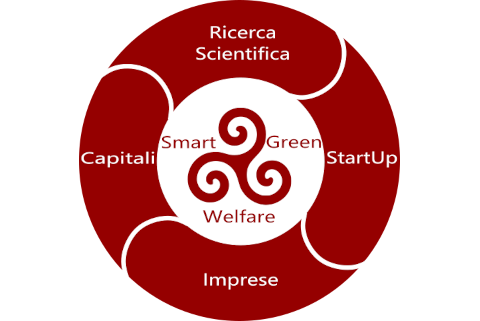
To address these challenges, it is essential to build a model of oriented knowledge networks, in which the university acts as a bridge between local development and geopolitical objectives. On one hand, the university must create synergies between symbolic resources, SMEs, and digital technologies, thus contributing to the growth of territory. On the other hand, it must collaborate with national and European institutions to develop strategic technologies in line with geopolitical needs.
Knowledge supply chains must be designed to support a dual mission: on one hand, connecting academic research to national and European technological infrastructures, and on the other, strengthening the local productive fabric, enhancing human and cultural capital, with the aim of stimulating concrete and lasting economic and social development.
Ultimately, the relationship between universities and territory requires a profound cultural change that goes beyond the limits of self-referential academic logic and recognizes the value of research as a tool for social, economic, and strategic progress. Only through a balance between local development and geopolitical oversight will it be possible to build a sustainable future for Italian communities and territories, making the university a key player in this process.