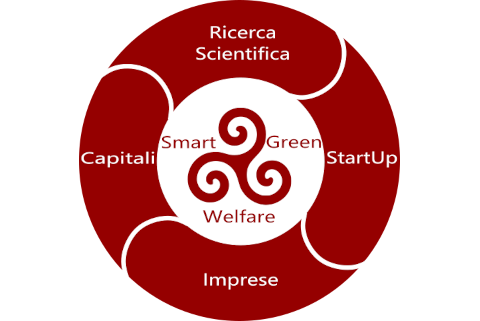

SmartLand: a model for the italian reality
Italy, with its reality of villages, small municipalities, and small to medium-sized cities, represents a unique territory characterized by cultural richness, landscape diversity, and a widespread historical heritage. However, this territorial fragmentation poses significant challenges to strategic planning and integrated development. Unlike large metropolitan cities, where the concentration of resources and population allows for the development of large- scale autonomous projects, smaller territories face structural limits, such as a lack of economic resources, skills, and the ability to relate to the global context.
In this context, the creation of shared governance structures becomes crucial to transform Italian territories into a smartland, that is, an integrated, resilient territorial system capable of competing at the national and international levels.
Territorial aggregation consists of bringing together different municipalities and villages into a supramunicipal structure, with the aim of overcoming administrative fragmentation and promoting the integration of resources and strategies. Furthermore, it aims to optimize internal functionalities, creating a coherent territorial system with shared services and integrated infrastructures. Finally, through this aggregation, the intention is to build a relational capacity towards the outside, facilitating the economic, cultural, and social promotion of the territory, both at the national and international levels.
This structure is inspired by metropolitan cities but with a model adapted to the reality of small centers. The result is a territorial district that functions as a systemic unit, capable of facing global challenges without losing local identity.
The Challenges of Italian Territories
Italian territories face various challenges related to their size and the distribution of resources. Most Italian municipalities have fewer than 5,000 inhabitants, which contributes to the fragmentation of the territory and makes it difficult to plan and implement integrated development projects. The limited resources and weak institutional capacity of these municipalities will exacerbate the situation. Furthermore, small centers often have limited access to the necessary resources, such as technical skills, economic resources, or technological tools, to participate in development programs at the national or European level. Another issue is the functional isolation of many villages, which are not well connected to nearby cities, reducing their effectiveness and limiting their attractiveness to investors. Finally, in some cases, competition among municipalities for scarce resources hinders the creation of a shared vision for development and promotes ineffective territorial management.
Shared Governance Structures
To address the challenges of Italian territories, it is essential to create shared governance structures that act as territorial development agencies in support of local authorities.
These structures must be able to promote an integrated vision of development, overcoming the particular interests of individual municipalities to work towards a common strategy. They must also effectively coordinate the available resources, optimizing the use of financial, human, and technological resources.
Moreover, they must facilitate municipalities’ access to available funds, supporting them in the design and management of projects funded by regional, national, and European programs.
Another important aspect is the creation of economies of scale through the sharing of services and infrastructures, which allow for cost reduction and increased efficiency. Finally, these structures must to act as unique interlocutors to represent the territory to higher institutions, investors, and other external partners, ensuring coordinated and strategic management of the territory.
Characteristics of a Territorial District like Smartland
- Systemic Unit: Each Municipality participates as part of an integrated system, with a clear distribution of roles and responsibilities.
- Ability to Generate Synergies: Projects are developed to maximize collective benefits, avoiding duplications and overlaps.
- External Attractiveness: The district becomes an attractive hub for investments, tourism, and culture, thanks to joint promotion.
- Innovation and Sustainability: The adoption of smart technologies and the transition to sustainable economic models are central priorities.
Key Steps for Creating a Smartland
To create a “Smartland”, it is necessary to follow some key steps.
The first step involves mapping the territory, a thorough analysis that allows for the identification of the involved Municipalities and available resources, while also identifying strengths and weaknesses.
Next, it is essential to define a shared governance, creating a territorial development agency with a clear mandate that ensures inclusive representation of all local entities. Once the governance structure is established, strategic planning follows, which involves developing an integrated plan based on shared objectives and measurable performance indicators.
Another crucial step is the integration of services, which involves the implementation of shared public services such as transportation, waste management, and digital infrastructure, in order to optimize costs and improve overall efficiency. It is also important to attract external resources, presenting the district as a unique interlocutor to access public funds and attract private investments.
Finally, constant monitoring is necessary, using appropriate tools to assess progress and adapt strategies based on the results achieved.
Territorial aggregation around a community-based integrated development project represents the only sustainable path for Italian villages and small municipalities that want to overcome fragmentation and face development challenges. Creating shared governance structures similar to those of metropolitan cities allows transforming a set of local entities into a systemic unit capable of acting as a smartland. Through resource optimization, collaboration among municipalities, and a shared strategic vision, Italy can enhance its territorial peculiarities and promote sustainable and inclusive development.